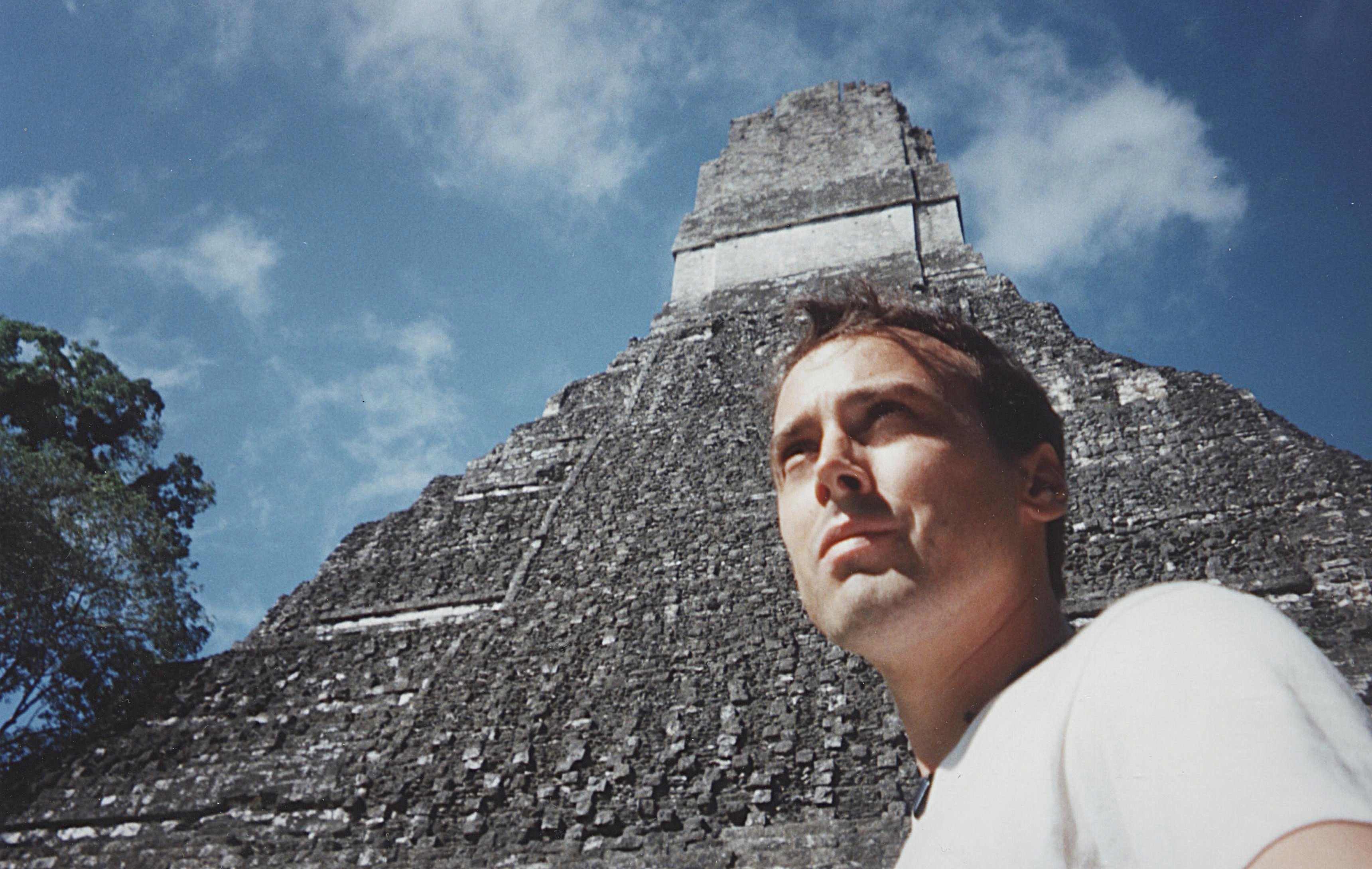
January 15, 7:00 a.m. I am standing atop the Temple of the Lost World. The panorama reveals the immensity of the jungle that forms the ecological reserve and the ancient Mayan city known as Tikal, in northeastern Guatemala. The sun is rising and a mist evaporates, revealing the morning flight of parrots, toucans, and other exotic bird species. The cries of howler monkeys echo for miles, and I see two spider monkeys hanging by their tails from fruit trees, feeding on nuts. I am in the company of a young German couple. We had rushed two kilometers to reach the pyramids, knowing full well that the spectacle of nature would not wait for us. After climbing the few hundred steep stone steps of the pyramid, we were breathless but jubilant. Twenty minutes later, we are silent, overwhelmed by humility in the face of the grandeur of this scene, knowing that words are inadequate and insufficient to truly grasp the moment. In front of us, nearly a kilometer away, we can see the summit of another pyramid rising above the dense vegetal canopy of the jungle. On this monument, where two thousand years ago the Maya sacrificed slaves to appease the god of death, named Cizin, about fifteen tourists are gathered, also admiring the serenity of Tikal. For me, this is one of those rare moments of ecstasy where, for a brief instant, I seem to capture the beauty of something in all its simplicity.
I experienced several such moments throughout my recent journey in Mexico, Cuba and Central America: at the summit of an active volcano in Guatemala, retracing the steps of Che Guevara in the jungles of the Sierra Maestra in Cuba, enveloped by the scent of incense and religious chants inside an esoteric church in Chiapas. These experiences were sublime and of pure beauty. Yet the simplicity rediscovered during these moments was only one aspect of the journey. Equally enriching were the many experiences encountered along the paths leading to Tikal and the Sierra Maestra—experiences characterized not by simplicity and beauty, but by complexity, uncertainty, and questioning.
A first example of this complexity is the act of traveling itself. Wandering through countries such as Guatemala, Honduras, El Salvador, and Nicaragua inevitably plunges the traveler into situations that are sometimes dangerous, often ridiculous, but always fascinating. Take, for example, road transportation.
It costs almost nothing to travel long distances by bus in Central America, but this is done mostly in old, dilapidated, overcrowded school buses, on roads that are often extremely narrow and rudimentary. Moreover, one must frequently change buses several times and at unpredictable moments—an effort that should qualify as an Olympic event. Typically, the exercise consists of grabbing one’s backpack in haste and rushing toward the next bus, which has already begun to move. While running, one throws the bag to the baggage attendant (the one gesticulating impatiently and shouting “Vamos, vámonos”), who climbs nonchalantly onto the roof to—one hopes—find a suitable place to store it. Then one squeezes inside the bus in an attempt to find a seat. To do so, one pushes, twists, and apologizes: “disculpa, disculpa.” Finally, one manages to glue a buttock onto the corner of a seat already occupied by two other people and settles in for the duration of the journey.
At first glance, this system seems ridiculous, especially when compared to North American transportation systems with their fixed schedules, assigned seating, and sanitized appearances. Indeed, my first experiences on these “collectivos” (vehicles bursting with bright exterior colors and filled with photos and religious ornaments above the driver’s seat) led me to scratch my head and wonder whether it wouldn’t be better to find other means of transportation, such as organized tours for tourists. But for some reason, I learned to appreciate these moments. Since then, I have often found myself in a state of euphoria, jumping from one collectivo to another in great haste, happy to travel among the indigenous people who themselves are generally curious to see a gringo traveling among them.
Another dimension of the complexity of travel lies precisely in the reasoning that takes place in the mind of the nomad. The independent traveler discovers many things about himself while traveling. He often finds himself in difficult situations, and the ways in which he manages them often surprise him, revealing unsuspected strengths and weaknesses of character.
In my case, nothing is more striking than observing the psychological process that overtakes me when I arrive in a large city for the first time. Arriving in a monstrosity such as Guatemala City or San Salvador is always an intimidating experience, especially in the evening. I become defensive, my head buried in my Lonely Planet guide, reading and rereading sections such as “Dangers and Annoyances.” With good reason, I never feel like venturing too far on that first night. On the contrary, the objective is to find a hostel as quickly as possible. And of course, nothing is more certain than the fact that if I arrive in the evening and slightly on edge, I never manage to find a room on the first try. I sometimes have to stifle a small feeling of panic after knocking on the door of a second or third hotel, where a receptionist announces with a slightly mocking smile that there are no rooms left for the night.
Yet my true fascination is not related to my nervousness during these first moments. Rather, what amazes me most is the radical transition that occurs in my attitude following my first exploration of the city. From an initial feeling of apprehension, I move, within the space of a few days, to confidence, a sense of familiarity, and, at the limit, an impression that the city belongs to me (imagine John Travolta on the streets of New York in Saturday Night Fever). Of course, I exaggerate a little, as I am never crazy enough to wander through the worst neighborhoods of formidable cities like Tegucigalpa (except by mistake). Nevertheless, when it comes time to leave the place a few days later, I can hardly conceive of my state of mind on that first evening.
There are all kinds of factors that contribute to such phenomena. I believe I understand that what allows me to plunge into risky situations (and I have experienced real ones) is first a slight suicidal tendency, or what I would call defiance. But deep down, what truly propels me forward is above all a desire to better know and understand the living conditions in the countries I visit. And it is when I engage in this quest that I discover a final element of complexity: the sociopolitical reality of these countries.
Westerners generally hold a simplistic view of countries of the South. Our history courses and news broadcasts typically paint one-dimensional portraits of these countries. They are constantly designated as “Third World” or “developing” countries, which carries the connotation of being backward in all aspects of life. Their populations are perceived as passive and incapable of taking matters into their own hands except through the generosity of developed countries. As for the political dimension, these countries are seen as puppets of great powers such as the United States and, during the Cold War, the Soviet Union.
It is true that these countries face great difficulties. The seven countries of Central America, as well as Mexico and Cuba, all have dramatic and tragic histories. But it must be recognized that these countries have experienced—and continue to experience—struggles and movements that lie at the heart of the great issues of our time. Throughout the twentieth century, they were marked by historic struggles for independence and against colonial and imperialist repression. Today, the major themes of economic globalization and environmental degradation mobilize thousands of people and hundreds of groups. These courageous peoples and their great leaders should be appreciated just as the great nations and political figures that have illuminated the West are appreciated. Unfortunately, their achievements are largely ignored or completely distorted, ultimately being perceived as insignificant.
Without a doubt, the country that embodies the greatest complexity and is most often misunderstood is Cuba, that Caribbean island which offers a rare example of a nation that resists the homogenization of corporatist capitalism and where the notion of revolution for social justice still resonates. This will be the subject of my next article, in approximately two weeks.