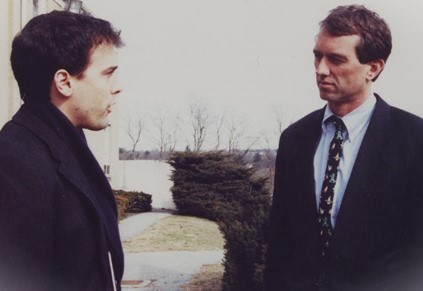
MICHEL LEBLANC strides across the frozen tarmac and with a handshake joins forces with one of the most powerful environmental organizations in the world.
At the other end of the handshake is Bobby Kennedy, Jr., son of the slain civil rights advocate and politician Robert Kennedy Sr.
The two are here in New York City on this frigid February morning to finalize the details of bringing the Riverkeeper organization to Moncton.
It’s a momentous occasion for both men; for Mr. Kennedy, it marks a new beginning for his eco-group – international expansion into Canada.
For Mr. LeBlanc, it’s a new weapon in the fight to open the causeway gates of the Petitcodiac River and restore the dying river before it’s too late.
Mr. LeBlanc says, eyes bright with determination: “[But] if we don’t open the gates that river will die.”
“With the creation of the Petitcodiac Riverkeeper, this has assured us that we’re going to be around – loud – for many years to come.”
In a few weeks, Ottawa and the province plan to open the Petitcodiac causeway gates. If conditions are right, the experimental gate-opening will provide crucial scientific evidence to help decide whether or not the gates should be opened full-time.
Local environmentalists support the plan, but some Greater Moncton residents oppose the gate opening, saying it will destroy the scenic blue headpond found on the upriver side of the causeway.
Until now, the anti-experiment groups have fought government and environmentalists to a standstill.
But the coming of the Riverkeeper tips the scale by giving local environmentalists the resources and support of a national organization dedicated solely to protecting rivers.
The Riverkeeper, through litigation, has forced river polluters to clean up their acts throughout the U.S.
Now the group is turning its eyes northward to help Michel LeBlanc and his fellow eco-warriors save the Petitcodiac.
Mr. LeBlanc is meeting with Mr. Kennedy at Riverkeeper’s environmental litigation clinic at Pace University in White Plains, N.Y.
The clinic, found just on the outskirts of New York City’s urban sprawl, is the main center for Riverkeeper’s legal work.
At the end of a long narrow hallway, Mr. Kennedy, Riverkeeper’s chief legal counsel, sits at a cluttered desk giving an interview with a major U.S. television network.
The legal clinic is buzzing with excitement. Earlier this morning, Mr. Kennedy dropped a bombshell report on the media that found that New York City’s water supplies were in serious jeopardy from terrorist attack.
Media here played it big, for when a Kennedy speaks, America listens.
Outside in the hallway, Michel LeBlanc is beaming. Mr. Kennedy is an idol of sorts for him and to be in the presence of one of the U.S.’s leading environmentalists is exhilarating.
“I came here to discover the spirit of the Riverkeeper and I think I’ve discovered it,” he says with a smile.
“This whole place exudes such energy and conviction. That’s the spirit we want to bring back home.”
This trip to the Big Apple is the culmination of years of fighting by Mr. LeBlanc and many others to save the Petitcodiac River.
Coming here is Mr. LeBlanc’s last duty before handing over the reins of Riverkeeper to his fellow environmentalists back home.
Riverkeeper is relatively unknown in Canada, but here in the U.S. the group is famous.
And no wonder: Riverkeeper, through its tough litigation of corporate polluters, has almost single-handedly cleaned up many of the most toxic rivers in the United States.
The student lounge here at Pace is a testament to Riverkeeper’s success.
A “wall of victory” contains photocopies of cheques written by corporations to Riverkeeper to pay for polluting local rivers: Orange and Rockland Utilities Inc., $175,750; F.C. Hastings, $50,000, with the words “Sweet Victory!!!” written beneath; oil companies Mobil and Chevron, $23,867 each.
Towns and cities have also felt the brunt of Riverkeeper’s legal wrath, as shown by cheques written to Riverkeeper by the town of Yorktown for $120,000 and the City of New York for $50,000.
The walls are also plastered with newspaper headlines citing victory after victory. But the most telling wall hanging is a poster of a hand-drawn cartoon head with bulging eyes. The eyes are fixed on an American dollar, with the following caption: Keep your eyes on the prize!
Mr. Kennedy emerges from his office, a tall figure with thick brown hair and piercing blue eyes. His blue dress shirt is rough around the edges, his tie slightly askew.
He pauses for a moment near the “wall of victory.”
“Some people want us to treat the planet like it was a business in liquidation and convert our natural resources into instant cash for a few years of pollution-based prosperity,” he says sadly. “But I have a big sense of loss when I see natural areas being destroyed.”
The Pace legal clinic is the linchpin of the Riverkeeper organization. It is here Mr. Kennedy teaches environmental law. More importantly, it’s where he leads a special law course where students earn their grades by prosecuting actual polluters.
Before the coming of the Riverkeeper, most American environmental groups were passive lobbyists.
Riverkeeper, however, believed that to clean up rivers, you had to hit corporations where it hurts the most – in their pocketbooks.
Riverkeeper was first founded in the early 1980s. Today, their successful lawsuits are used as case-law precedents for a legion of environmentalists across America.
But this powerful organization did not spring out of thin air.
It began humbly, with a small group of fishermen on the Hudson River who were tired of watching their once-vital river turned into a toxic disgrace by some of America’s most powerful companies.
They recruited a local man, John Cronin, to be the first Riverkeeper, adopted Mr. Kennedy as their chief lawyer, and together changed the face of the environmental movement in America.
Now Riverkeeper is in Canada – and the group couldn’t be any happier.
“We’re really happy,” Mr. Kennedy says. “We’ve had interest from all over Canada in starting ‘keepers, but this is the first one that’s come to fruition. We hope to ultimately have ‘keepers on every water body in North America.”
Many concerned citizens believe they are powerless to stop big industry from polluting their rivers.
Riverkeeper, Mr. Kennedy says, has proved those people wrong, for the fishermen of the Hudson weren’t high-paid lobbyists or political savants.
“Many of them didn’t have college educations,” he says. “They simply felt strongly about their river and felt it was being stolen. And the polluters they went up against were the most powerful entities in this country.”
Mr. Kennedy sees the Petitcodiac as a prime example of a river in need of a ‘keeper.
Few people in Greater Moncton worried about the Petitcodiac in the years following the building of the causeway.
Indeed, common consensus in the 1960s and seventies was that the Petitcodiac was a brown blight on the city – especially when compared to the beautiful headpond created on the upriver side of the causeway.
“I remember as a youngster seeing Lake Petitcodiac and thinking: ‘Oh, what a wonderful blue lake,’ ” Mr. LeBlanc says. “I never in my whole life thought of the Petitcodiac River as a dying river. It was a joke.”
The causeway, however, was no laughing matter.
Built in 1968, the causeway immediately started plugging the river with silt. Today, the river channel has narrowed from more than a mile in width to less than 150 meters.
The causeway has also killed off many breeds of fish, including the Atlantic salmon, that used to ply its rivers and spawn.
Mr. LeBlanc formed the eco group Ecoversité in 1993 and immediately started fighting to open the gates.
In 1994, Mr. LeBlanc wrote to Mr. Kennedy and asked for his help.
Mr. LeBlanc grins as he recalls that day just over four years ago when Mr. Kennedy flew into Moncton to throw his weight behind the fight.
Mr. Kennedy met with local media near the river and gave a short speech. He then donned a pair of waist-high firemen’s galoshes and, to the utter shock of the assembled reporters, waded into the river.
“He put on these huge fireman boots . . . and wandered off into muddy banks of Petitcodiac – and then he sank up to his waist in the mud,” Mr. LeBlanc says with a hearty laugh.
“He was almost stuck and I remember only one thought going through my mind – that we may have to call the fire department to pull him out.”
Mr. Kennedy eventually managed to find his footing and emerged muddied but triumphant. A photo of a muck-splattered Mr. Kennedy standing with Mr. LeBlanc today owns a place of honour on the law clinic’s walls.
Mr. LeBlanc says Mr. Kennedy’s visit gave environmentalists in Moncton the boost they needed.
“It was a watershed moment. I do believe it was the defining moment in this issue,” Mr. LeBlanc says. “That crystallized it for us. We had not been a confrontational group until then. That’s when we became militant.”
Mr. Kennedy and his law students stare down Mr. LeBlanc in a downstairs meeting room.
They grill him with questions about the Petitcodiac. Few of them know where the river is, and some aren’t even sure which province “up there” is New Brunswick and which is Nova Scotia.
But all the lawyers listen intently, because their expertise may some day be needed on the Petitcodiac.
The lawyers have heard many arguments against environmentalism.
A familiar refrain is that environmentalism costs jobs. That excuse drives Mr. Kennedy crazy with frustration.
Sitting in his office, he sighs heavily as he recalls some of the many tough legal battles he’s fought and won.
“Good economic policy is always good environmental policy,” Mr. Kennedy says. “They’re the same thing.”
“Environmentalism is not about pitting humans against fish, or humans against trees. It’s about being fair to the next generation, to say that we live off the bounty of the land, but we’re not going to use them up.”
Riverkeeper’s main weapon is litigation. It sees itself as an environmental watchdog that barks each time environmental-protection laws are broken.
The Petitcodiac causeway gates are currently violating federal law that makes it illegal to block fish passage in rivers.
If necessary, Riverkeeper is willing to sue governments to open the gates.
But even the Riverkeepers say that litigation is the last line of offence.
Kevin Madonna, Riverkeeper’s chief recruiter, helped bring many of the present-day Riverkeepers into being.
Near his desk is a wall map of North America. Dozens of coloured pins dot the map, each thin sliver of metal representing the location of a Riverkeeper group. A bright blue pin pokes out of Moncton, N.B.
Mr. Madonna says Riverkeeper’s success depends on working with, not against, communities.
“The ‘keeper concept is that communities are responsible for their water bodies,” Mr. Madonna says. “It’s communities that pollute it and those communities have a responsibility to clean it up.”
“But if you just start throwing a lot of lawsuits around, you’re going to alienate a lot of people. No ‘keeper can be an island – the ‘keeper doesn’t solve problems, communities solve problems.”
Mr. LeBlanc believes that Ottawa and the province have a duty to uphold the law and open the gates. He intends to take the lessons learned here back to Moncton and with the help of newly appointed Petitcodiac Riverkeepers Gary Griffin and Daniel LeBlanc, finally succeed in righting the 30-year-old wrong that is the Petitcodiac Causeway.
“The Department of the Environment is there to protect the environment. The Department of Fisheries and Oceans is there to allow fish passage,” Mr. LeBlanc says. “We’re saying you have a responsibility to restore this river. That’s the bottom line.”